


Welcome back to No Fixed Path. The lack of posting here means I’ve been busy, which I don’t take for granted in this market. It what’s sparked the need to write on what I’m seeing happening at an an accelerated pace of this growing AI wave: we’re susceptible to paralysis of choice. There’s not just several tools for everything, you can just make it yourself! Or wait a little longer for the model to build your solution.
This piece is about the hesitancy in the market. I’m feeling it, and you and your team may be feeling it too. How should companies sell software in this era?
There’s a meeting happening everywhere right now. The founders / buying committee have done its homework. The product demo went well. The pricing is within budget. Stakeholders are aligned in principle. And then someone asks the question that reliably derails the whole thing: “Shouldn’t we wait to see how this category shakes out before we commit?”
Nobody pushes back hard. The decision: hold.
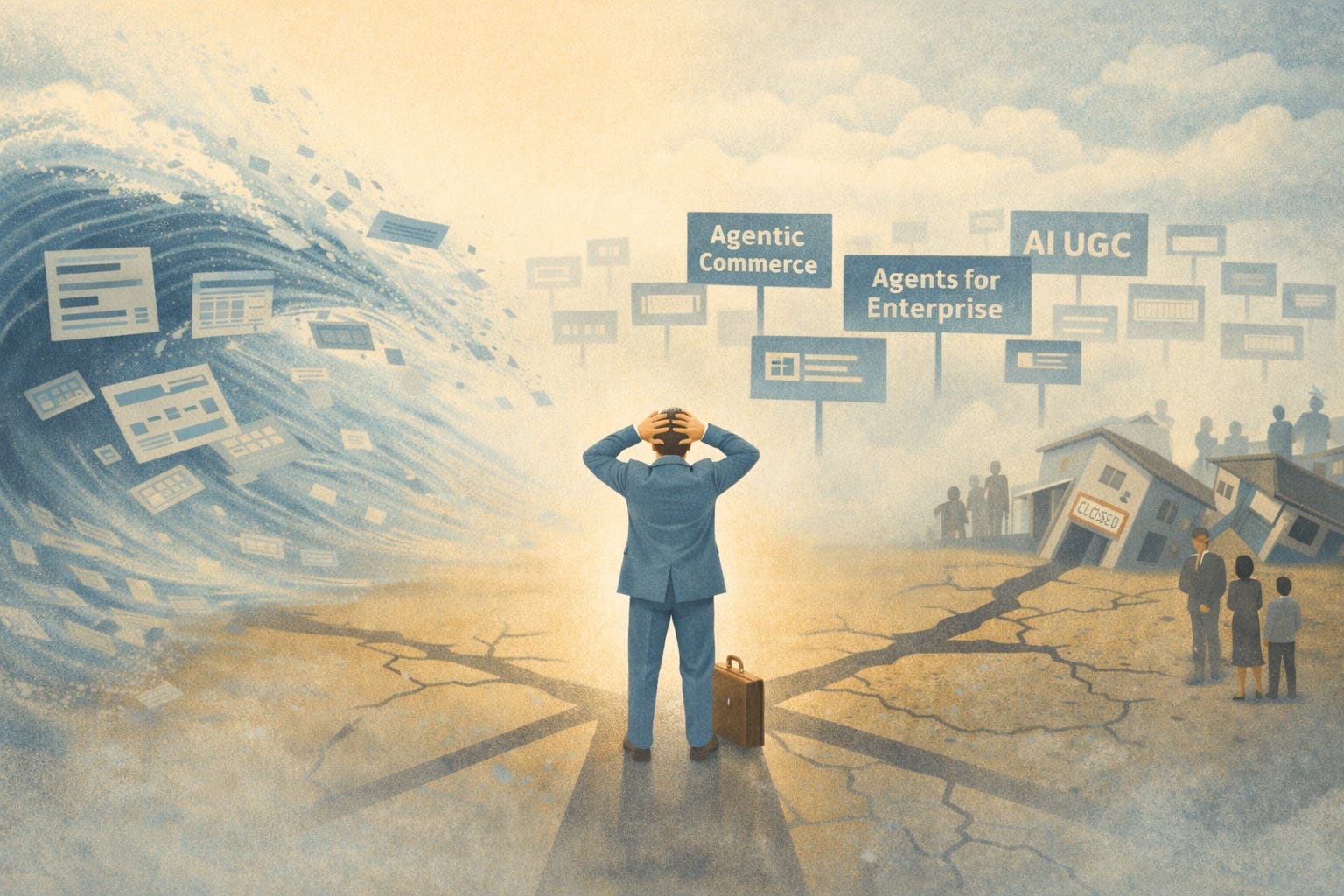
This is the freeze. It is one of the defining dynamics in B2B software buying right now, and most GTM teams aren’t designed to address it. If my experience is any indication, it’s happening in B2C too. What products are worth using today? Are they worth using tomorrow?
Stack Overflow's 2025 Developer Survey (65,000 respondents) described the market in two words that have stuck with me: "willing but reluctant." That's a market-trust problem, and most GTM teams aren't built to solve it.
The conventional wisdom on buyer hesitation focuses on friction: too expensive, wrong feature set, integration complexity. Those objections have solutions. Lower the price. Build the integration. Shorten the trial period. The freeze resists all of those interventions because the objection isn’t about the product as it exists today. It’s a forecast problem. Buyers are being asked to make a bet on the future state of a market that is genuinely hard to forecast. And the rational response to genuine uncertainty, for many buyers, is to not bet at all.
The buyer question has shifted. It used to be: “Is this the best tool for this job?” Now it’s: “Is this the right time to buy any tool for this job?” That question has no process. We rationalize it because it keeps humans productive doing what we’ve always done. But it produces delay.
Why This Is Structurally Different
Software buying hesitation isn't new. What's new is the underlying mechanism: temporal uncertainty. It doesn't care how good your product is today. It's a question about your product's position in a market six months from now.
A legal team evaluating Harvey right now faces exactly this. Anthropic just announced native legal tooling built into Claude. Does Harvey's moat hold? Does the category collapse into the foundation model layer? Harvey is better positioned than most to capture durable value in legal AI. But it's natural to hesitate. Committing to a vendor layer above a platform feels premature when the platform keeps moving down the stack. That hesitation is rational. It's also the freeze.
Three structural forces are driving it simultaneously.
The pace of AI capability acceleration has decoupled product development from buyer decision-making. A category leader from 2023 can find itself in legacy status by 2025 because a newer entrant rebuilt core functionality with an AI-native architecture. X is full of this: the "another AI wrapper" critique became a legitimate procurement instinct, not just a dismissive meme. Buyers who made reasonable purchasing decisions two years ago are watching some of those bets expire: Two-thirds of software buyers now experience purchase regret or implementation disruptions (Gartner, 2025). That number changes how every subsequent decision gets made.
Vendor mortality risk has become real for the first time in a generation. Buyers have watched vendors get acquihired, pivoted into something unrecognizable, or quietly shut down mid-contract. It now factors into buying logic within procurement, within teams, and in your own personal decision-making. That's a market where sellers can't close and buyers can't commit.
The proliferation of new entrants has collapsed the signal that used to help buyers orient. When a category has three serious competitors, you can do a real evaluation. When it has forty startup vendors, most of which launched in the past 9 to 18 months and are largely indistinguishable from the outside, the rational move is to wait for a winner. The problem is that no winner is emerging on a timeline that matches a buyer’s patience. Employees are increasingly being tested on their ability to scale themselves with AI tools. Meanwhile, 90% of workers say they’re overwhelmed by the number of software tools they already use, and 59% say it’s harder than ever to be productive as a result. More options, less clarity, higher cost of being wrong.
Put these together and you get a buyer type that didn’t exist five years ago: the well-qualified, budget-approved, legitimately interested prospect who won’t commit until the market settles. And the market isn’t settling.
This is me, by the way. These days I vacillate between trying five products that are 95% similar and the urge to wait for Claude to build the functionality instead. Every day there’s new product from Anthropic and a hundred new startups launching on X only to face this cognitive dissonance: do I bet on the great AI-native SaaS product that leverages a model in a genuinely usable UX? Or the LLM that does 80% of that for free through a chat interface? The “I just use ChatGPT for that now” pattern is real. I’ve said it. You’ve said it. Software vendors are losing deals to it.
How The Freeze Shows Up
Sales cycles are elongating, and founders are increasingly reporting being ghosted at the finish line by promising deals that unexpectedly go quiet without a clear rejection. It’s not price, consensus, or economic pressure. The buyer is waiting for a catalyst the normal deal motion doesn’t provide. No discount addresses temporal uncertainty. The average B2B buying cycle stretched to ten months in 2025. The buying journey itself has shifted to 60% software selection, 40% validation. Buyers are spending significantly more time pressure-testing whether a category will hold, not just whether a product is good.
Free tier retention is climbing while paid conversion flatlines. Seventy percent of enterprises haven’t moved beyond basic integration of the AI tools they already have. The free tier hasn’t failed them. It’s become the rational default. Commitment feels premature. Free is the right answer for a buyer who has decided to wait without deciding to leave.
Churn concentrates at renewal with customers citing “evaluating alternatives.” A significant portion of this isn’t product-driven. It’s buyers who were never fully committed treating the renewal window as a re-evaluation checkpoint. They came in willing to try. They’re not willing to recommit without more confidence that the category itself is stable.
Each symptom has a conventional intervention. None of them work because they’re addressing the wrong diagnosis.
What Software Builders Should Do
You can’t fully solve temporal uncertainty through sales tactics. Some buyers are going to wait regardless. The goal is to separate freeze-induced hesitation from hesitation that’s actually about your product. Its also about building growth-oriented GTM motions for buyers who don’t yet trust the market. Many well-advised founders understand the value of PLG in this environment where so many are paralyzed by choice.
Compete on compounding value, not roadmap promises. If a buyer’s concern is that your product may be obsolete in eighteen months, showing a roadmap isn’t the answer. Roadmaps are promises, and buyers worried about the future don’t find promises reassuring. The better answer is genuine institutional depth: the data your product accumulates about their business, the workflow integrations that take months to rebuild, the context a new tool starts without. That’s a more convincing response to temporal uncertainty than any feature preview. It fosters a growing commitment from your customers.
Make low-commitment onboarding a deliberate strategy. A recent HBR study found that AI tools don’t reduce work, they intensify it. Employees worked faster, took on broader scope, extended work into more hours. That’s the real onboarding burden buyers are weighing before they sign. The right response isn’t to discount harder toward an annual contract. It’s to design a PLG path where short-term commitment leads naturally to long-term commitment because the customer hit visible value at thirty, ninety, and one-eighty days. A customer who comes in monthly, converts at month four, and stays for three years is more valuable than an annual contract extracted before they were ready. Rejecting the long term contract is probably the only part of “SaaS is dead” that likely has real legs.
Make the case for your durability explicitly. Profitable businesses, well-capitalized companies, and clear category leaders all have something to say to a buyer worried about vendor mortality. That case belongs in your sales narrative. Say it directly: how long you’re capitalized, what your retention looks like, why you’ll be around. Buyers won’t infer it from a funding announcement.
What Software Buyers Should Do
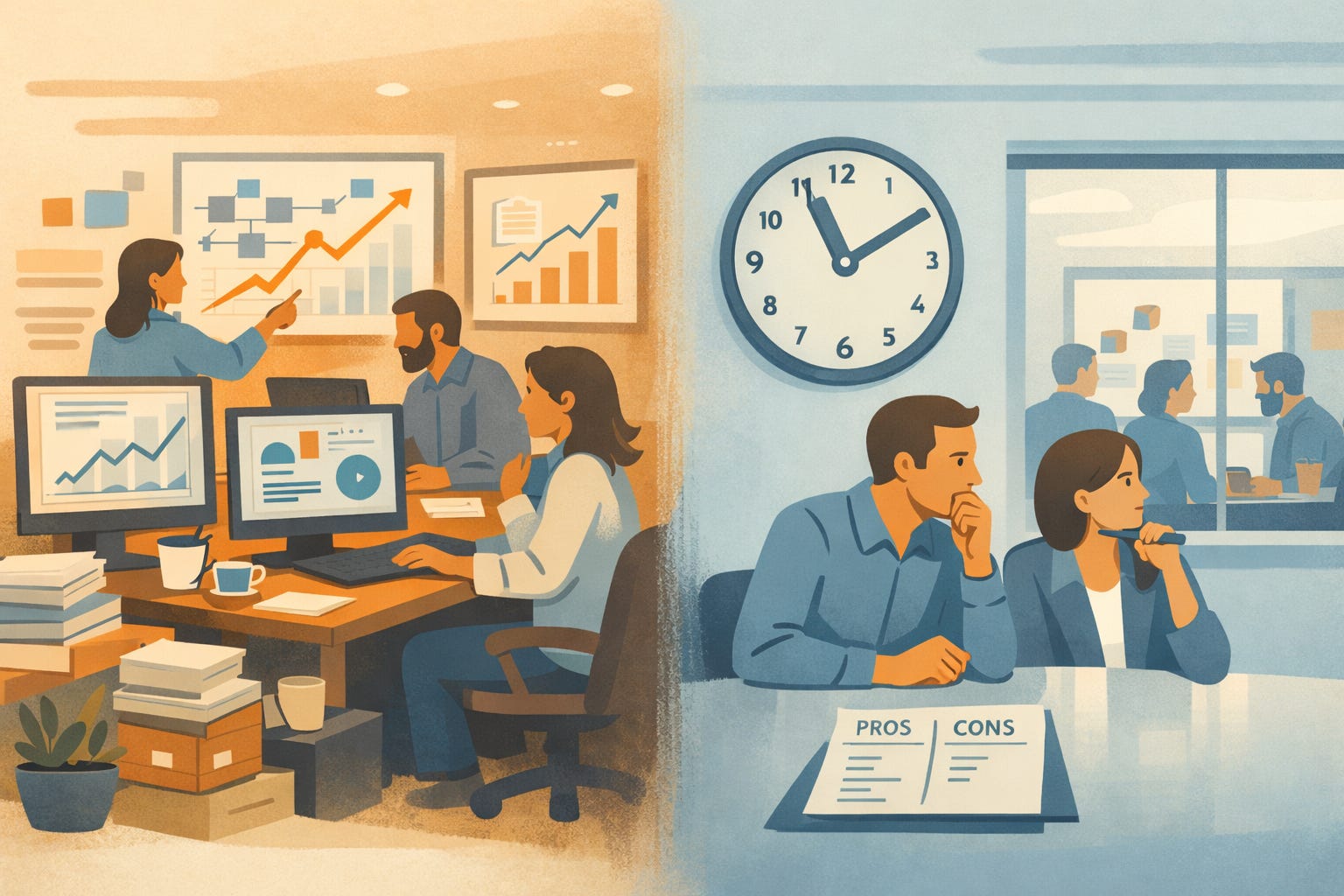
The freeze is rational behavior. But rational isn’t the same as optimal.
Thirty percent of organizations are already wasting money on redundant AI software they’re barely using. The answer isn’t to buy more, but to buy smarter and move faster on the ones that clear the bar. The tools buyers are deferring decisions on are being actively used by their competitors right now. A team that spent six months building with an AI-powered operations tool while another team debated whether to wait for the next model release didn’t just save time. They built workflows, institutional habits, and organizational knowledge that takes months to replicate. The cost of not deciding accumulates quietly.
A workable framework: if switching costs are genuinely low and the technology is in flux, optimize for reversibility. Start with PLG-oriented self-serve products where you can experience real activation value before committing to anything. Buy short-term, stay mobile, don’t build deep integrations into tools you might replace in a year. If the job-to-be-done is stable even when the tool market isn’t, optimize for current fit. You can always switch when something better emerges, and the cost of switching a good tool for a better one is almost always lower than six more months on a worse workflow.
The consolidation signal is already visible. VCs are publicly predicting that enterprises will spend more on AI in 2026 but through fewer vendors. The market is telling you a winner-take-most dynamic is coming in most categories. The time to act on that signal is before the winner is obvious.
Certainty Always Arrives Late
Software markets do consolidate. Winners emerge. Categories that look chaotic from inside the disruption often look obvious in retrospect.
The buyers who wait for certainty will find themselves in a familiar position: the signal becomes clear at exactly the moment early adopters have already built the institutional knowledge, the workflows, and the data depth that latecomers start without. Certainty is a lagging indicator. It arrives after the window closes.
For software builders, the implication is direct. Your GTM motion needs to be designed for buyers who don’t trust the market yet, not just buyers who haven’t been convinced about your product. That’s a different problem. The discount doesn’t solve it. The feature doesn’t solve it. Low-friction entry, compounding value, and the confidence to commit do.
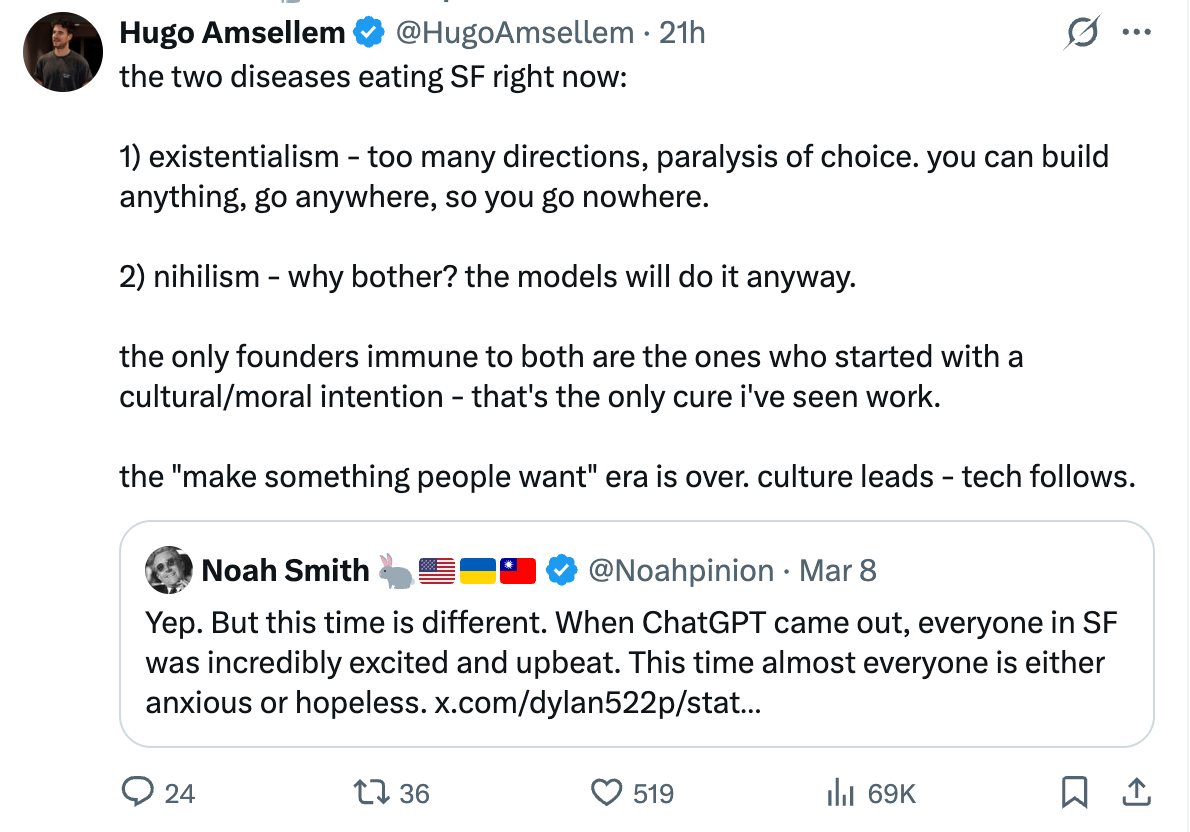
It’s a weird time. On every level. There’s a fear that pure software is uninvestable right now. The moats are disappearing and founders may not even know what’s worth building going forward.
But we all need software. For every instance, we’ll decide when we are best served by AI-native SaaS, personalized software, or the LLMs we use. Most are happy to pay for the right value exchange, so the key is to encourage product exploration and earn the commitment, and institutional investment, of your customers as the ground continues to shift under our feet.